

ANFF New South Wales
Overview
The NSW Node of ANFF is split between the University of New South Wales (UNSW), the University of Sydney and the University of Technology Sydney (UTS).
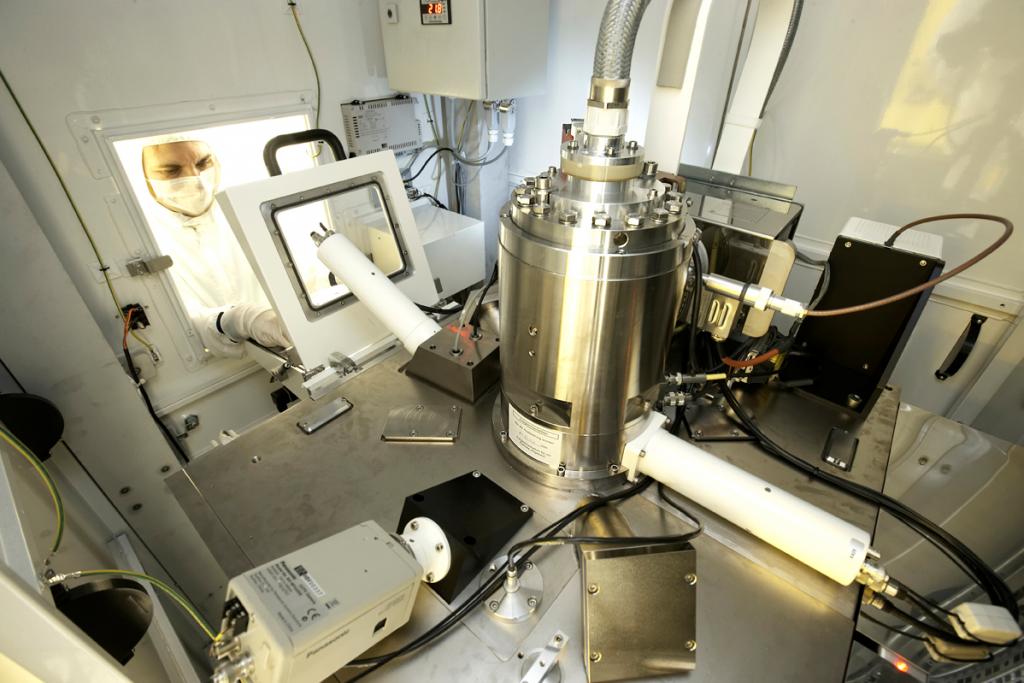
The core area of expertise for ANFF’s activities at UNSW includes nanoelectronics, with both Si-MOS and GaAs devices with sub-50 nm feature sizes routinely produced using the hub’s suite of high-resolution EBL systems within a 600 m2 laboratory complex providing cleanrooms with particle counts equivalent to ISO5, ISO6 and ISO7. The full range of research disciplines regularly supported by ANFF NSW @ UNSW is broad, encompassing quantum computing, biomedical devices, nanophotonics, medical detectors and photovoltaics.
ANFF NSW equipment at the University of Sydney forms part of the Sydney Nano Foundry, a Core Research Facility based at the Sydney Nanoscience Hub. The Sydney Nano Foundry enables the development of optical chips, electronic devices and new quantum science and technology via outstanding lithography, etching, deposition and metrology capabilities.
Node Competencies
Specialist fields: nanoelectronics (Si-MOS and GaAs); semiconductor device processing; optics; quantum technologies; photovoltaics.
Flagship facilities: high resolution EBL systems, including the flagship Raith 150TWO; UV lithography equipment; a range of deposition systems and etching tools; high temperature silicon oxidation, diffusion and annealing furnaces; wet chemical process lines; a suite of metrology tools; device packaging and bonding tools.
Contact
Node Director: TBA
Email: TBA
Phone: +61 2 9385 6311
Facility Manager: Matthew Boreland
Email: m.boreland@unsw.edu.au
Phone: +61 2 9385 7845

Location
University of New South Wales
Address
Level 3 Newton Building
The University of New South Wales
Sydney NSW 2052
University of Sydney
Address
Sydney Nanoscience Hub
University of Sydney
NSW 2052
University of Technology Sydney
Address
UTS Science
Building 7, Thomas St
Ultimo NSW 2007
Mailing Address
UTS Science Store
Building 1, Level 2, Thomas St
Ultimo NSW 2007
Equipment
Experts

Dr Matthew Boreland
(MATH-yoo BORE-luhnd)
Technical Director
As the NSW Node's Technical Director, Matt is responsible for strategic development and high level operational control in line with University and government priorities and research goals. He was appointed to this role in 2017 after many years of international experience is research and research/facility management. Dr Matt Boreland has over twenty-five years' experience in the field of photovoltaics, renewables and semiconductors, predominantly at the industry-research interface, with international experience in Australia (UNSW, Sydney University), Japan (Toyota Technological Institute), the UK (Loughborough University) and Singapore (UNSWASIA, NUS). He received his BSc(hons) in Physics and his PhD in photovoltaics (PV) at UNSW. To date he has been directly involved in attaining in excess of AUD 30 million of industrial and public funding for photovoltaic research in the UK, Singapore and Australia. In addition to research expertise, he has a diversity of experience in engineering, management and academic roles up to Director and Associate Professor levels. Following his PhD he was a JSPS Postdoctoral at the Toyota Technological Institute in Japan. He then joined the Centre for Renewable Energy Systems Technology (CREST) as an academic at Loughborough University in 2002 where he led R&D and teaching programs in PV, subsequently taking a joint-appointment at Sydney University in 2004 to also lead their industrial solar thermal R&D. In 2008 he was a founding member of the Solar Energy Research Institute of Singapore (SERIS) as the Deputy Director (later Director) of the Silicon Cluster and Head of Production Technologies, where he established SERIS' $15M pilot line for Si PV R&D and leading industrial R&D programs in silicon photovoltaics. Dr Boreland returned to UNSW in 2013 to the School of Photovoltaic and Renewable Energy Engineering as Associate Professor. In 2017 he accepted the role as Business Facility Manager at the NSW Node of the Australian National Fabrication Facility (ANFF) located at UNSW.
Read More
Laboratory Infrastructure
University of New South Wales
Contact Dr Matthew Boreland
Mr Roger Ackroyd
(RODGE-er ACK-royd)
Senior Process Engineer: Thin Film Deposition
Roger is a Senior Process Engineer: Thin Film Deposition at ANFF-NSW University of Sydney. He spent the last 4 years working as a nanofabrication process engineer for Microsoft Quantum. In this role, and prior to this at UNSW, he worked on several devices and materials systems, including superconductors, semiconductors, qubits, microwave resonators, Josephson junctions, and SQUIDs. His focus is on process development, process improvement, and scale-up.
Read More
Deposition, Etching, Lithography, Modelling and Design, Modelling and Device Design
University of Sydney
Contact Mr Roger Ackroyd

Anna Adams
(anna ADD-uhms)
Executive Assistant to Director
Anna provides executive support to the ANFF-NSW Node Director and administrative support to the ANFF-NSW team. Anna ensures the efficient management of the ANFF-NSW office functions. Anna has extensive secretarial and office management experience gained from working in the banking and finance industries prior to joining ANFF in 2017.
Read More
University of New South Wales
Contact Anna Adams
News
NOxZora receives ANFF-C pre-seed funding
November 6, 2026
Cirnetiq receives ANFF-C pre-seed funding
November 2, 2026
2026 Frater Awards: Backing ANFF staff to go further
October 28, 2026
‘ANFF DELIVERS’ showcases Australian innovation
October 27, 2026
ANFF Forum 2026: Strengthening the Network
October 26, 2026
University of Sydney gas gauge receives ANFF-C pre-seed funding
August 31, 2026
Valetudo receives ANFF-C pre-seed funding
August 27, 2026
VoltAmmonia receives ANFF-C pre-seed funding
August 25, 2026
3rd ANFF Labs Who Care Workshop
August 13, 2026
Deneb Space advances autonomous satellite technology with ANFF-C support
July 24, 2026
François Ladouceur Departs ANFF-NSW
July 24, 2026
iQ Sense receives ANFF-C support for animal health innovation
July 23, 2026
Publications
2024
2023
2022
2021
2020
2019
Simultaneous study of acoustic and optic phonon scattering of electrons and holes in undoped GaAs / Alx Ga1 − x As heterostructures
Applied Physics Letters
,
Year: 2024
,
Vol. 125
,
Issue: 25
Shape Programmable and Multifunctional Soft Textile Muscles for Wearable and Soft Robotics
Advanced Intelligent Systems
,
Year: 2024
,
Vol. 6
,
Issue: 9
Platelet Adhesion and Activation in an ECMO Thrombosis-on-a-Chip Model
Advanced Science
,
Year: 2024
,
Vol. 11
,
Issue: 30
Improved flux and anti-fouling performance of a photocatalytic ZnO membrane on porous stainless steel substrate for microalgae harvesting
Journal of Membrane Science
,
Year: 2024
,
Vol. 694
Alignment assessment of anisotropic liquid crystals through an automated image processing algorithm
Journal of Molecular Liquids
,
Year: 2024
,
Vol. 408
Deep Learning Assisted Long-Range Microwave Photonic Sensing Using Reflective Microdisk
2024 International Topical Meeting on Microwave Photonics, MWP 2024
,
Year: 2024
Terahertz Extreme Skin-Depth Waveguides
IEEE Transactions on Terahertz Science and Technology
,
Year: 2024
,
Vol. 14
,
Issue: 5
Electronic Correlations in Multielectron Silicon Quantum Dots
Proceedings of the IEEE Conference on Nanotechnology
,
Year: 2024
Synthesis of Anisotropic Gold Microparticles via L-Glutathione-Mediated Pathways in Droplet Microfluidics
Particle and Particle Systems Characterization
,
Year: 2024
,
Vol. 41
,
Issue: 10
Tailorable ITO thin films for tunable microwave photonic applications
Optics Express
,
Year: 2024
,
Vol. 32
,
Issue: 11
Monolithically integrated mode converter from terahertz substrateless silicon guide to conductive slotline
Applied Physics Letters
,
Year: 2024
,
Vol. 125
,
Issue: 7
Navigating the 16-dimensional Hilbert space of a high-spin donor qudit with electric and magnetic fields
Nature Communications
,
Year: 2024
,
Vol. 15
,
Issue: 1